
7 Swords of St. Michael Prayer: A Powerful Spiritual Shield Against Evil
St. Michael the Archangel has been a source of comfort for centuries. People turn to him in hard seasons, scary nights, and quiet mornings alike. His name means “Who is like God?” — a simple phrase that carries enormous weight.
This guide walks through the two most well-documented prayers connected to St. Michael: the short Prayer to St. Michael written by Pope Leo XIII, and the older Chaplet of St. Michael, built around nine short petitions to the angelic choirs. You’ll find the full text of each, where they came from, and how people pray them today. No guesswork, no invented lines — just the prayers as they’ve been passed down.
Who Is St. Michael the Archangel?
Scripture names St. Michael directly, more than once. The Book of Daniel calls him “the great prince” who stands guard over God’s people. The Book of Revelation describes him leading heaven’s armies against a dragon, the ancient symbol of Satan. Catholic tradition has held him up ever since as a defender — of the Church, of the faithful, and of anyone who calls on him by name.
He’s typically pictured with a sword and a set of scales, sometimes standing over a defeated serpent. That image isn’t decoration. It’s a visual shorthand for what people believe he does: fight for souls, weigh what’s right, and stand between danger and the people he’s asked to protect.
Two prayers carry most of that tradition forward today. One is short enough to say in thirty seconds. The other takes ten or fifteen minutes and moves through nine distinct angelic choirs. Both are real, both are old, and both are still prayed daily by people all over the world.
The Prayer to St. Michael by Pope Leo XIII
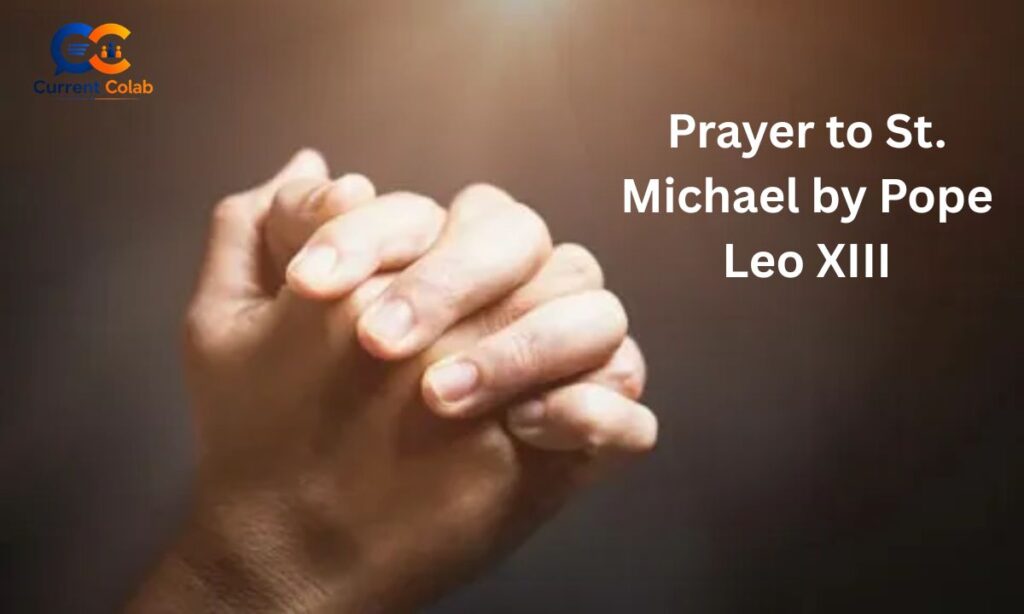
This is the prayer most Catholics know. It’s short, direct, and built for repetition — the kind of prayer you can say standing in a grocery line or lying awake at 2 a.m.
Where It Came From
Pope Leo XIII added this prayer to the Mass in 1886. From that year until 1964, priests recited it after every Low Mass throughout the Catholic Church, though it was never written into the Mass’s official text or rubrics. A well-known story claims the Pope wrote it right after a disturbing vision involving Satan and a hundred years of attack against the Church — but the earliest version of that story only surfaced in a 1933 newspaper article, and a priest who tried to trace it back further found no proof it ever happened. Whatever sparked it, the prayer itself stuck. It’s been recited daily by millions of people for well over a century.
In 1964, the instruction Inter oecumenici lifted the requirement to say it after Mass. Plenty of parishes never stopped anyway, and many Catholics still add it to their personal prayer routine today.
The Short Version
This is the form most prayer cards, parish bulletins, and apps use:
St. Michael the Archangel, defend us in battle. Be our protection against the wickedness and snares of the devil. May God rebuke him, we humbly pray, and do thou, O Prince of the heavenly host, by the power of God, thrust into hell Satan and all the evil spirits who wander through the world seeking the ruin of souls. Amen.
That’s the entire prayer. No buildup, no closing meditation — just a direct ask, repeated daily by people who find it grounding.
The Longer Version
Fewer people know there’s a longer original behind the short prayer above. Pope Leo XIII first added a set of prayers after Low Mass back in 1884, asking God’s help for the Holy See during a period when the papacy had lost its temporal authority. The Michael prayer joined that set in 1886, and in its fuller form it reads more like a petition than a one-line plea — asking St. Michael to “offer our prayers in the sight of the Highest” and to help “beat down the dragon, the ancient serpent.” Some parishes and prayer groups still use this extended version, particularly during Lent or in groups dedicated to spiritual warfare devotions.
One caution worth passing along: a separate, much longer exorcism-style prayer also circulates online under Leo XIII’s name. That formula was written for bishops and authorized exorcists only, never for general use. In 2020, the International Association of Exorcists publicly warned that improper use of that exorcism text by priests or laypeople “can have more or less serious spiritual consequences.” If you come across a long, intense exorcism prayer attributed to Leo XIII, that’s the one to leave to clergy — the short and long prayers above are the ones meant for everyday use.
Also read this blog: Zuhr Prayer: Complete Guide to Time, Rakats, and How to Pray (2026)
The Chaplet of St. Michael: A Prayer to the Nine Choirs of Angels
If the Leo XIII prayer is a quick word at the door, the Chaplet of St. Michael is a longer visit. It moves through nine separate angelic choirs, one petition at a time, and takes most people ten to fifteen minutes to complete.
Where It Came From
The chaplet traces back to a private vision given to Antonia d’Astonac, a Portuguese Carmelite nun, in 1751. In that vision, St. Michael told her he wanted to be honored through nine salutations, one for each choir of angels, and Pope Pius IX formally approved the devotion in 1851.
The promise attached to it has kept the devotion alive for generations. St. Michael told Antonia that anyone who practiced the chaplet would receive an escort of nine angels — one from each choir — when approaching Holy Communion. For those who prayed it daily, he promised his continual protection during life, and after death, help for themselves and their loved ones still in purgatory. Padre Pio is said to have recommended it often to people struggling with temptation.
What Are the Nine Choirs of Angels?
Catholic tradition, drawing on scattered scripture references, holds that angels are organized into nine distinct choirs, or ranks. Scripture itself doesn’t lay this list out in one place — it’s pieced together from Isaiah, Genesis, Colossians, Ephesians, and Romans — but tradition has settled on nine: Seraphim, Cherubim, Thrones, Dominations, Virtues, Powers, Principalities, Archangels, and Angels. The Chaplet of St. Michael prays through every one of them, asking for a different grace from each.
How to Pray It
The chaplet is traditionally prayed on a set of beads — nine groups, each with one large bead and three small ones — though counting on your fingers works fine if you don’t have a set. Begin with the Sign of the Cross, then pray the opening line: “O God, come to my assistance. O Lord, make haste to help me.” For each of the nine choirs, you say one Our Father on the large bead and three Hail Marys on the small ones, with a specific salutation read before each group.
Here are all nine salutations, each followed by one Our Father and three Hail Marys:
- First Choir — Seraphim: By the intercession of St. Michael and the heavenly choir of the Seraphim, may it please God to make us worthy to receive into our hearts the fire of his perfect charity. Amen.
- Second Choir — Cherubim: By the intercession of St. Michael and the heavenly choir of the Cherubim, may God in his good pleasure grant us grace to abandon the ways of sin and follow the path of Christian perfection. Amen.
- Third Choir — Thrones: By the intercession of St. Michael and the sacred choir of the Thrones, may it please God to infuse into our hearts the spirit of true and sincere humility. Amen.
- Fourth Choir — Dominations: By the intercession of St. Michael and the heavenly choir of the Dominations, may it please God to grant us grace to have dominion over our senses and to correct our depraved passions. Amen.
- Fifth Choir — Powers: By the intercession of St. Michael and the heavenly choir of the Powers, may God vouchsafe to keep our souls from the wiles and temptations of the devil. Amen.
- Sixth Choir — Virtues: By the intercession of St. Michael and the admirable heavenly Virtues, may it please God to keep us from falling into temptation, and may He deliver us from evil. Amen.
- Seventh Choir — Principalities: By the intercession of St. Michael and the heavenly choir of the Principalities, may it please God to fill our souls with the spirit of true and sincere obedience. Amen.
- Eighth Choir — Archangels: By the intercession of St. Michael and the heavenly choir of Archangels, may it please God to grant us the gift of perseverance in the faith and in all good works, that we may attain the glory of paradise. Amen.
- Ninth Choir — Angels: By the intercession of St. Michael and the celestial Choir of Angels, may the Lord grant us to be protected by them in this mortal life and conducted in the life to come to Heaven. Amen.
After the ninth salutation, pray one Our Father in honor of St. Michael, then one each for St. Gabriel, St. Raphael, and your own guardian angel.
Closing Prayer
Most versions of the chaplet end with this prayer, said on the medal or after the final Our Father:
O glorious prince St. Michael, chief and commander of the heavenly hosts, guardian of souls, vanquisher of rebel spirits, servant in the house of the Divine King and our admirable conductor, you who shine with excellence and superhuman virtue, deliver us from all evil, who turn to you with confidence, and enable us by your gracious protection to serve God more and more faithfully every day. Pray for us, O glorious St. Michael, that we may be made worthy of His promises. Amen.
When People Pray the Chaplet
There’s no required schedule. Some people pray it daily as a personal devotion, while others save it for a novena leading up to Michaelmas on September 29th, or pray it on Tuesdays, which tradition has long set aside for St. Michael. Either approach is fine — the chaplet doesn’t come with strict rules about timing, only an invitation to keep showing up.
Living Under God’s Protection Daily
Neither of these prayers is meant to replace prayer to God — both are requests for St. Michael to intercede, to carry a need before God on someone’s behalf. That distinction matters. Catholic tradition has always been clear that angels assist; they don’t act as a substitute for God’s own grace.
What both prayers offer, in their own way, is a sense of not being alone in whatever you’re carrying. The short Leo XIII prayer fits into a hard moment — a rough morning, a tempting decision, a flash of fear before sleep. The chaplet asks for something slower: a daily rhythm, nine small requests stacked one after another, each aimed at a different kind of strength.
You don’t need beads, a quiet chapel, or perfect words to pray either one. You need a few minutes and a willingness to ask.
Conclusion
The Prayer to St. Michael and the Chaplet of St. Michael have survived for well over a century between them, prayed by popes, parish priests, and ordinary people looking for steadiness in hard moments. Neither one needed updating, embellishing, or modernizing to stay relevant — they’ve simply been passed down, word for word, because the words still hold up.
If you’re searching for a prayer to lean on, start with whichever one fits your day. Thirty seconds with the short Leo XIII prayer, or fifteen minutes with the full chaplet — both are real, both are old, and both are still being prayed today by people asking St. Michael to stand with them.

I am a prayer writer with 4+ years of experience in creating faith-based content. I share daily prayers, powerful prayer guides, and inspiring messages for every occasion. My goal is to help readers strengthen their faith with simple, meaningful, and easy-to-read prayers. Every prayer is written with care to bring hope, peace, and encouragement each day.